
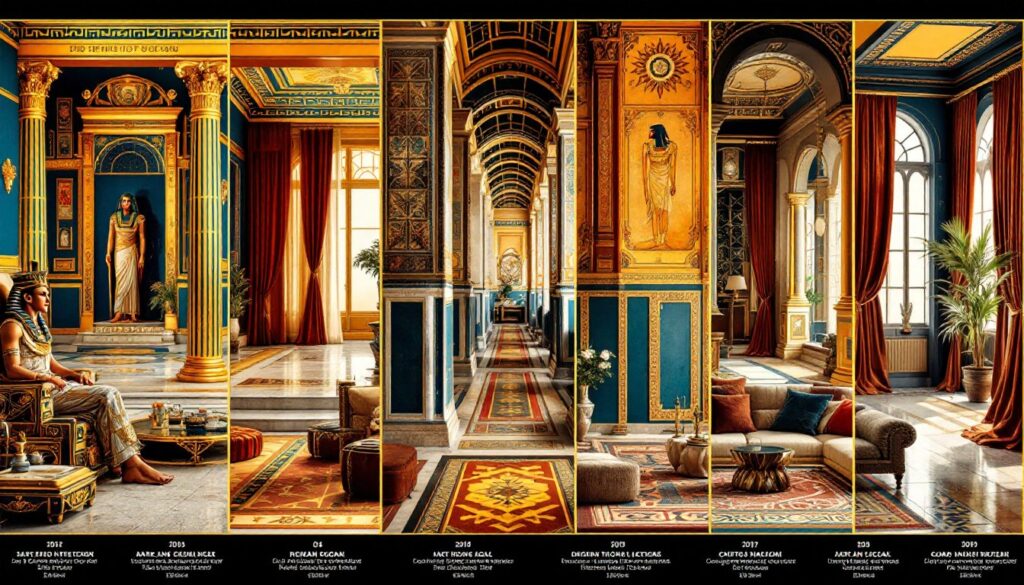
Interior design isn’t a modern invention, it’s a practice rooted in human civilization itself. From the moment our ancestors decorated cave walls with ochre pigment to the pharaohs commissioning gilded chambers, people have shaped their living spaces to reflect status, culture, and aesthetic values. The history of interior design reveals how practical needs, available materials, technological advances, and shifting social values have continuously redefined what we consider beautiful and functional. Understanding this evolution helps today’s homeowners and designers make informed choices about their own spaces, bridging timeless principles with contemporary trends.
Key Takeaways
- The history of interior design spans millennia, from ancient Egypt’s symbolic use of color and spatial hierarchy to today’s pluralistic approach, proving that design reflects cultural values and priorities rather than following timeless rules.
- Major movements—Arts and Crafts, Modernism, and contemporary design—established core principles: Medieval craftspeople prioritized durability, the Renaissance unified aesthetics through proportion and perspective, and Modernists proved that form should follow function without unnecessary ornamentation.
- Interior design transitioned from exclusive luxury for pharaohs and nobility to accessible styles for the middle class, with industrialization and movements like Art Deco democratizing design while pushing innovation forward.
- Contemporary interior design embraces eclecticism and personalization, incorporating biophilic design and sustainability concerns while drawing freely from historical periods—a philosophy grounded in understanding design history.
- Understanding interior design’s evolution enables today’s homeowners and designers to make informed choices that balance timeless principles like balance, proportion, and quality with modern values like environmental responsibility and authentic self-expression.
Ancient and Classical Periods: The Birth of Intentional Interior Design
Interior design as a deliberate practice emerged in ancient civilizations where wealth and power allowed for more than basic shelter. In Ancient Egypt, elaborate tombs and temples featured symmetrical layouts, rich color palettes, deep blues, reds, and golds, and furniture designed for both function and ceremony. The Egyptians understood spatial hierarchy: pharaohs’ chambers dominated with scale and ornamentation while servants’ quarters remained modest.
Greek and Roman interiors took a different approach. The Romans developed the atrium, a central hall with surrounding rooms, creating flexible, light-filled spaces. They pioneered the use of mosaics, frescoes, and marble to convey wealth and taste. Pompeii’s preserved homes reveal that Romans separated public and private spaces intentionally, with receiving rooms (atriums) showcasing elaborate decoration while bedrooms remained simpler. Color was bold: deep reds, yellows, and earth tones dominated walls.
These ancient civilizations established principles still relevant today: balance, proportion, the strategic use of color, and the relationship between form and function. They proved that interior design was never merely decorative, it communicated social standing and cultural values.
Medieval and Renaissance Transitions: Luxury Meets Craftsmanship
Medieval interiors reflected the era’s hierarchical society and religious devotion. Castles and great halls featured heavy wooden beams, arched stone walls, and minimal furniture, practicality dominated. Tapestries served multiple purposes: they insulated drafty stone walls, added color, and displayed wealth through intricate weaving. Medieval designers prioritized durability over ornament: a chair needed to last generations and withstand constant use.
The Renaissance marked a dramatic shift. Originating in Italy around the 14th century, Renaissance design celebrated human achievement and classical learning. Interiors became galleries, walls displayed art, carved wood paneling replaced bare stone, and furniture became sculptural. The Renaissance introduced the concept of the room as a unified aesthetic experience. Perspective, proportion, and symmetry, borrowed from classical architecture, guided interior layouts.
Furniture design flourished during this period. Tables, chairs, and chests evolved from purely functional to ornately carved pieces. Velvet, silk, and brocade fabrics replaced coarse wool. Color palettes expanded to include rich jewel tones, emerald, sapphire, and burgundy, often paired with gold leaf accents. The Renaissance established that interior design required knowledge of architecture, art, and craftsmanship, a philosophy that shaped professional design for centuries.
The Industrial Revolution and Art Movements: Design for the Masses
The 18th and 19th centuries saw interior design democratized through industrialization. Mass production made furniture and decorative objects affordable for the emerging middle class, not just nobility. Neoclassical, Rococo, and Victorian styles each reflected their era’s values, yet all emphasized ornamentation and historical references.
Victorian interiors epitomized maximalism: dark wallpapers, heavy drapery, dense furniture arrangements, and collections of objects crammed onto surfaces. Wealthy Victorians displayed their status through abundance. But, this aesthetic eventually triggered backlash from designers and reformers who saw overdecoration as wasteful and spiritually hollow.
The Arts and Crafts Movement
Emerging in late 19th-century Britain, the Arts and Crafts Movement rejected industrial mass production and Victorian excess. Led by figures like William Morris, practitioners championed handcrafted objects and honest materials. They believed design should celebrate the maker’s skill and the inherent beauty of materials, wood grain, natural fiber texture, and traditional joinery became design statements.
Arts and Crafts interiors favored simplicity, quality construction, and nature-inspired motifs. Furniture was substantial but unadorned: walls featured nature-based wallpapers or plain plaster. This movement proved influential: it established the principle that good design didn’t require expensive ornamentation, and it paved the way for modernism by rejecting historical pastiche in favor of honest expression.
Art Deco and Modernism Take Hold
The early 20th century brought radical transformation. Art Deco (1920s–1930s) embraced geometric forms, bold colors, and luxurious materials, chrome, glass, lacquer, and exotic woods. It was modernism’s glamorous cousin: forward-looking in form but unapologetically decorative. Art Deco interiors celebrated the machine age with streamlined furniture, zigzag patterns, and sunburst motifs.
Simultaneously, the Modernist movement (pioneered by the Bauhaus school in Germany) advocated pure functionalism. Modernists rejected ornament entirely, arguing that form should follow function. Clean lines, primary colors, and industrial materials, steel, concrete, glass, defined the aesthetic. Bauhaus designers like Marcel Breuer created iconic furniture (the Wassily chair) that merged art and utility.
These movements differed philosophically but shared a rejection of historical styles. Both declared that design should reflect contemporary life, not imitate the past. By mid-century, Modernism dominated high-end interiors and architecture. The message was clear: design should be honest, efficient, and innovative, not nostalgic. This shift fundamentally changed how designers approached space, material, and beauty.
Contemporary Interior Design: From Postmodernism to Today
The late 20th century saw modernism’s stranglehold loosen. Postmodernism (1970s–1980s) reintroduced color, pattern, and historical references, but ironically, playfully, not reverentially. Postmodern interiors mixed styles deliberately: a Victorian mirror hung in a minimalist room, bright patterns clashed cheerfully, eclecticism became acceptable.
Simultaneously, minimalism took root, an extreme reduction of Modernism. Japanese aesthetics influenced Western designers: negative space, neutral palettes, and essential objects only became aspirational. Minimalism reflected both spiritual seeking and practical fatigue with excess.
Today’s interior design is pluralistic. Scandinavian design emphasizes simplicity and functionality with warmth: industrial style celebrates raw materials and exposed structure: maximalism has returned, celebrating color and pattern. Contemporary designers draw from all historical periods while incorporating sustainability concerns and technology.
Current trends, biophilic design (nature-inspired spaces), adaptive reuse, and personalization over trends, reflect modern values: wellness, environmental responsibility, and authentic self-expression. The history of interior design has taught us that aesthetics aren’t timeless absolutes but expressions of cultural priorities. Today’s homeowners can draw on centuries of knowledge while creating spaces that genuinely reflect their lives.
Conclusion
The evolution of interior design mirrors human civilization’s shifting priorities, from displaying power and wealth to celebrating craftsmanship, then embracing innovation, and finally achieving personal expression. Each historical period left lasting lessons: ancient cultures showed us proportion and spatial hierarchy: the Renaissance taught us to treat rooms as unified compositions: Arts and Crafts emphasized quality and honesty: Modernism proved form could serve function beautifully. Today’s designers and homeowners inherit this rich vocabulary, free to borrow from any era while creating spaces that authentically reflect contemporary life. Understanding where design came from helps us design more thoughtfully for where we’re going.